
Practical Tips, Common Mistakes & Real Examples for American Job Seekers
In today’s ultra-competitive job market, your CV (curriculum vitae) is more than just a document—it’s your first impression. U.S. recruiters spend an average of 6–8 seconds scanning each CV. That means you only get one shot to stand out.
Whether you’re applying for your first job or pivoting into a new career, this guide will walk you through how to write a CV that gets noticed, avoid common mistakes, and include powerful examples to help your application shine.
What Is a CV and How Is It Different from a Resume?
In the U.S., the terms CV and resume are often used interchangeably. However:
-
A resume is a short, tailored summary of your skills and experience (1–2 pages max).
-
A CV is typically used in academic, research, or medical fields and is longer, including full publications, certifications, etc.
In this article, we’re focusing on how to write a job-winning resume-style CV for most U.S. jobs.
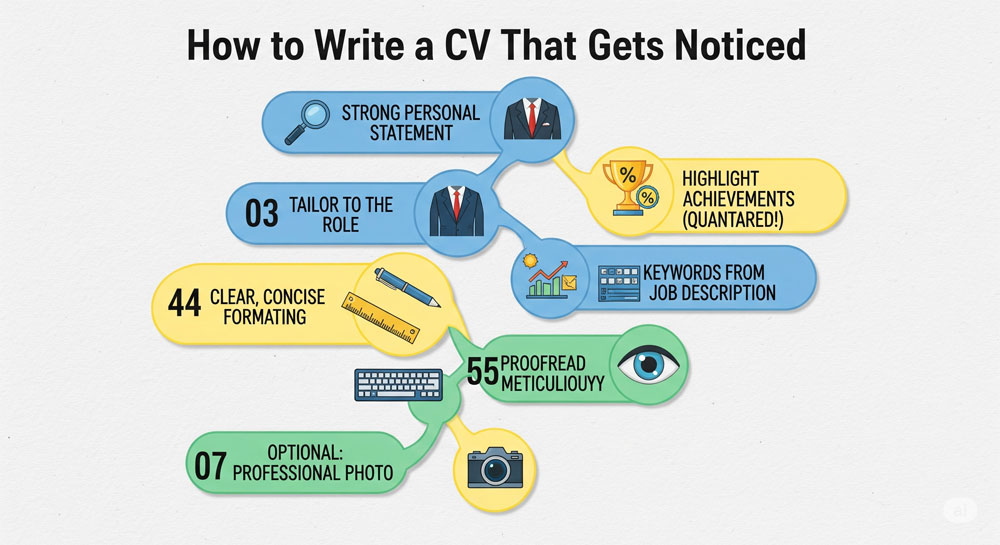
Step-by-Step Guide to Writing a CV That Stands Out
1. Start with Contact Information
Make it clean and professional:
-
Full Name
-
Phone number
-
Email address (avoid outdated or quirky names)
-
LinkedIn profile (optional but recommended)
❌ Don’t include: full home address. It’s unnecessary and outdated for most jobs.
2. Craft a Strong Summary (Not Objective!)
Avoid cliché objectives like “Looking for a challenging role where I can grow…”. Instead, write a Professional Summary that highlights:
-
Your current role
-
Years of experience
-
Key skills or achievements
-
Target industry
✅ Example:
Results-driven marketing professional with 5+ years of experience in B2B lead generation. Proven track record of increasing conversions by 30% using data-driven email campaigns.
3. List Key Skills (ATS-Friendly!)
Use job description keywords here. Examples include:
Hard Skills:
-
SEO, CRM tools, Python, Graphic Design, Project Management
Soft Skills:
-
Communication, Time Management, Leadership, Collaboration
Use bullet points and avoid skill bars or graphics, which many Applicant Tracking Systems (ATS) can’t read.
4. Work Experience with Achievements (Not Duties!)
Each role should include:
-
Job Title
-
Company Name, Location
-
Dates (Month & Year)
-
3–5 bullet points using action verbs and numbers
❌ Bad Example:
Responsible for managing sales team and maintaining records.
✅ Good Example:
Managed a team of 5 sales reps, achieving a 25% increase in quarterly revenue through targeted campaigns.
Use quantifiable results wherever possible.
5. Education
Include:
-
Degree
-
School Name
-
Graduation Year
-
Relevant achievements (Dean’s List, GPA if above 3.5)
Example:
B.A. in Business Administration
University of California, Los Angeles — 2022
GPA: 3.8 | Dean’s List (2 years)
6. Certifications, Awards, Projects (Optional but Powerful!)
This is your chance to stand out further. Add:
-
Google Ads Certification
-
Project Management Professional (PMP)
-
Volunteer work
-
Personal projects or portfolio link
Common CV Mistakes to Avoid
-
Typos and Grammar Errors
Use Grammarly or another proofreading tool. Ask a friend to review. -
Too Long or Too Short
Stick to 1 page (2 max if 10+ years of experience). -
No Tailoring
Sending the same CV to every job? Big mistake. Always tweak for the job posting. -
Buzzwords Without Evidence
“Team player”, “hardworking”, and “go-getter” mean nothing without proof. -
Overdesigning
Avoid fancy templates with colors, graphics, or multiple columns. Most ATS systems can’t read them properly.
Real Examples of Before & After CV Improvements
| Before | After |
|---|---|
| “Helped manage social media” | “Scheduled and published 50+ social media posts monthly, increasing engagement by 40%” |
| “Responsible for customer service” | “Handled 50+ daily customer queries, resolving 95% within 24 hours” |
| “Worked with team on new website” | “Collaborated with 3 developers to launch a new website, reducing bounce rate by 25%” |
Pro Tips for an ATS-Friendly CV
-
Use standard fonts: Arial, Calibri, Times New Roman
-
Avoid tables, columns, and graphics
-
Save as .docx or PDF (check job post)
-
Mirror keywords from the job description
Example: If the job description says “project coordination,” use that exact phrase—not “project management.”
Tailor Your CV for Each Job: Quick Checklist
✅ Change your summary based on the job
✅ Highlight relevant experience first
✅ Include skills & tools listed in the posting
✅ Use industry language the recruiter understands
❓ FAQs About Writing a CV for U.S. Jobs
Q: Should I include a photo?
A: No. It’s not customary in the U.S. and may violate anti-bias policies.
Q: Do I need to list references?
A: No. Use “References available upon request” if needed—or skip entirely.
Q: Can I use a template?
A: Yes—but choose clean, ATS‑friendly ones. Avoid Canva-style designs for U.S. corporate jobs.
Ready to Build a Powerful CV?
Download our Free U.S. CV Template
Download CV Template
Need feedback? Drop your CV in the comments or email us, and we’ll review it!
Final Thoughts
A great CV is your passport to interviews. When it’s tailored, error-free, achievement-focused, and ATS-optimized, it becomes a powerful job-seeking tool.
Start today. Polish your CV, tailor it for your dream role, and show them why you’re the best candidate.
Key Takeaways
-
Start with a clear structure
-
Tailor content using keywords from job descriptions
-
Showcase achievements with numbers and results
-
Avoid formatting mistakes that break ATS
-
Keep it concise, clean, and powerful