A few months ago, a school teacher told me something that stayed in my mind.
“I’m not afraid of hard work,” he said. “I’m afraid of becoming irrelevant.”
That fear is becoming very common.
Every day, we hear about Artificial Intelligence doing things that once needed humans—writing articles, answering customers, analyzing data. Tools from companies like OpenAI, Google, and Microsoft are improving very fast.
So naturally, people are asking:
👉 Will my job still exist in five or ten years?
👉 What should I learn now to stay safe?
Let’s talk about this honestly—without fear, and without hype.
Automation Is Not the End—It’s a Shift
When machines started entering factories, people thought jobs would disappear forever. That didn’t happen. Jobs changed.
The same thing is happening again.
According to the World Economic Forum, millions of jobs may disappear in the next few years—but even more new jobs will be created.
What does this really mean?
👉 It means the type of work is changing.
👉 It means the skills that matter are changing.
And most importantly:
👉 It means we have to change too.
The Jobs That Are Quietly Disappearing
Let’s be real. Some jobs are already fading.
If your work is:
- Repeating the same task every day
- Following fixed rules
- Not requiring much judgment
then it is at risk.
Think about:
- Data entry jobs
- Basic call center roles
- Cashiers
- Routine accounting tasks
Machines don’t get tired. They don’t need breaks. And they make fewer mistakes.
So naturally, companies are moving in that direction.
But here’s the important part:
👉 This is not a story of loss. It’s a story of replacement.
What Machines Still Cannot Do
Despite all the hype, machines still struggle with some very human things.
They cannot truly:
- Understand emotions
- Build trust
- Inspire people
- Handle complex human situations
And that is where your opportunity lies.
If your work involves:
- People
- Ideas
- Decisions
You are already in a safer position.
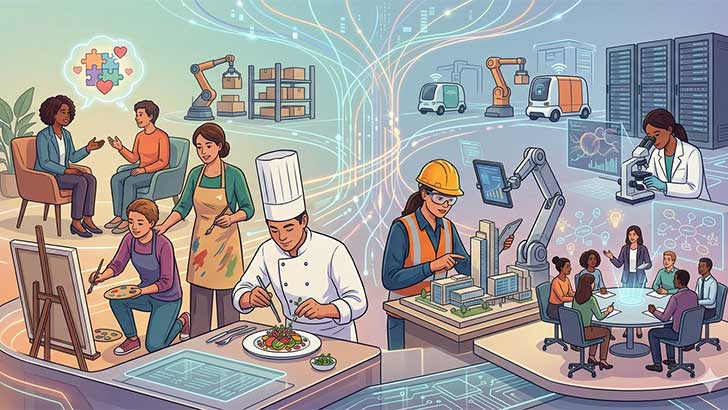
The Safest Jobs Are More Human Than Ever
Let’s look at this in a more practical way.
1. Education: More Than Just Teaching
A good teacher does more than explain lessons.
A good teacher:
- Understands a student’s fear
- Builds confidence
- Shapes character
AI can explain a math problem.
But it cannot sit beside a struggling child and say, “You can do this.”
That is why education, training, and child development roles are becoming more important—not less.
2. Healthcare: Where Empathy Matters
Imagine a patient in pain.
Would they trust a machine completely?
Maybe for reports.
But not for comfort.
Doctors, nurses, and caregivers bring something AI cannot replicate—human care.
And that will always be needed.
3. Leadership: Making the Hard Decisions
Data is everywhere today.
AI can give you reports, predictions, and suggestions.
But when things go wrong—
when people disagree—
when tough choices must be made—
👉 Someone has to take responsibility.
That’s leadership.
And that cannot be automated easily.
4. Creative Work: The Power of Original Thought
Yes, AI can generate designs, videos, and content.
But ask yourself:
👉 Does it truly understand your culture?
👉 Does it feel your story?
Real creativity comes from experience, struggle, and perspective.
That’s why creators who bring authenticity will always stand out.
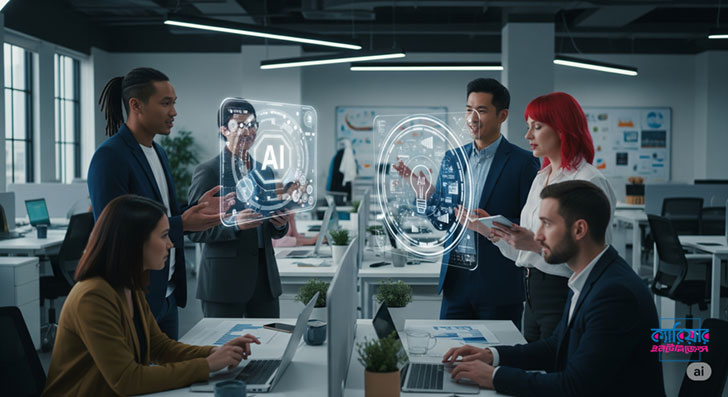
5. The New Winners: People Who Use AI
Here is a truth many people are slowly realizing:
👉 AI will not replace you.
👉 A person using AI will replace you.
Reports from LinkedIn and McKinsey & Company show that hybrid roles—where people combine technology with human skills—are growing the fastest.
These include:
- AI-assisted professionals
- Data-driven decision makers
- Digital educators
So the question is not: “Will AI take my job?”
The better question is:
👉 “Am I learning how to use AI?”
Skills That Will Protect You
Let’s simplify everything into one idea.
Your safety does not come from your job title.
It comes from your skills.
Focus on building:
- Clear communication
- Critical thinking
- Emotional intelligence
- Adaptability
- Digital understanding
These are not just “nice skills.”
They are survival skills now.
A Practical View for Bangladesh
In Bangladesh, the change may feel slower—but it is coming.
And when it comes, it will be strong.
For educators, trainers, and institution leaders, this is actually a powerful opportunity.
You can:
- Move into digital education
- Train others in future skills
- Build online platforms
- Create multiple income streams
👉 The people who act early will have a big advantage.
The Real Question You Should Ask Yourself
Instead of asking:
❌ “Is my job safe?”
Ask:
✅ “Am I growing fast enough to stay relevant?”
Because in today’s world, standing still is the biggest risk.
Final Thought
Automation is not here to destroy your future.
It is here to test you.
- Are you willing to learn?
- Are you willing to adapt?
- Are you willing to grow beyond your comfort zone?
Because the future will not belong to the strongest or the smartest.
👉 It will belong to those who keep learning.